Cardioscope

Abstract:

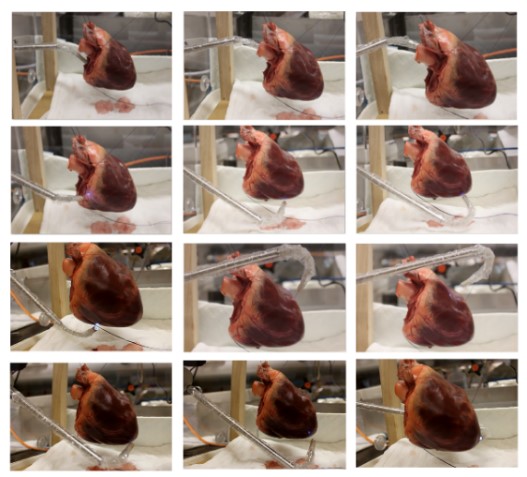
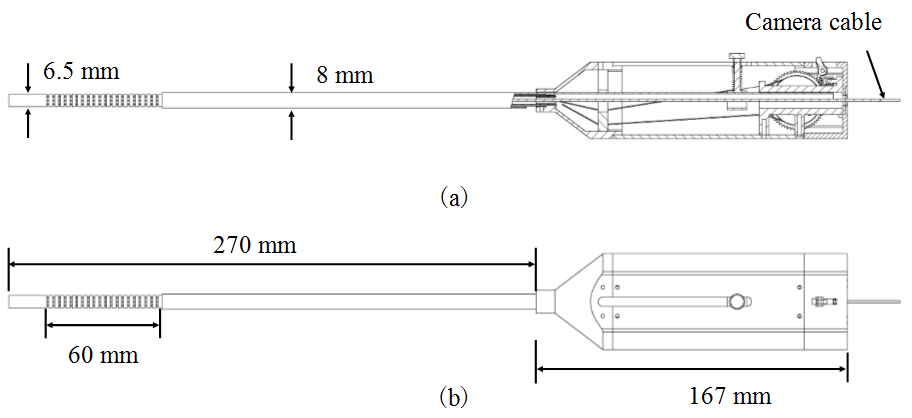
We present a novel flexible endoscope (FE) which is well suited to minimally invasive cardiac surgery (MICS). It is named the cardioscope. The cardioscope is composed of a handle, a rigid shaft, a steerable flexible section, and the imaging system. The flexible section is composed of an elastic tube, a number of spacing disks, a constraint tube, and four wires. It employs the constrained wire-driven flexible mechanism (CWFM) with a continuum backbone, which enables the control of both the angulation and the length of the flexible section. Compared to other endoscopes, e.g., rigid endoscope (RE) and fixed-length FE, the cardioscope is much more dexterous. The cardioscope can bend over 180โ€‰deg in all directions, and the bending is decoupled from the distal tip position. Ex vivo tests show that the cardioscope is well suited to MICS. It provides much wider scope of vision than REs and provides good manipulation inside confined environments. In our tests, the cardioscope successfully explored the full heart through a single hole, which shows that the design is promising. Despite being designed for MICS, the cardioscope can also be applied to other minimally invasive surgeries (MISs), such as laparoscopy, neurosurgery, transnasal surgery, and transoral surgery.
Demo video

Publications

  • Z. Li; M. Zin Oo; V. Nalam; V. Duc Thang; H. Ren; T. Kofidis & H. Yu Design of a Novel Flexible Endoscope- Cardioscope Journal of Mechanisms and Robotics, ASME, 2016, 8, 051014-051014
  • Z. Li; M. Z. Oo; V. D. Thang; V. Nalam; T. Kofidis; H. Yu & H. Ren Design of a Novel Flexible Endoscope – Cardioscope 2015 IDETC: ASME 2015 International Design Engineering Technical Conferences , 2015
Shape Morphing Microscale Soft Robotic Actuators

Abstract

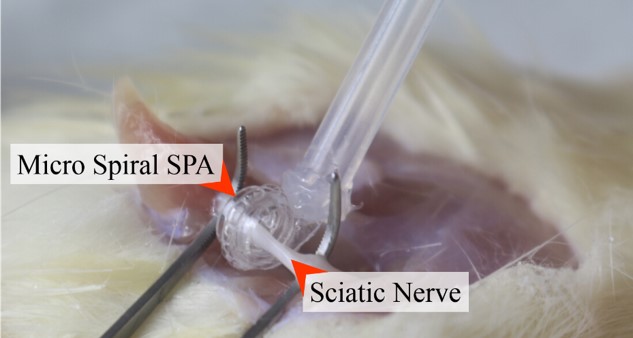
The micro actuator has been studied for its application in micro operations such as manipulating cellular aggregate, the tissues or drug delivery. The traditional actuation methods include thermo-mechanical actuation, electromagnetic actuation, electrostatic actuation and pneumatic actuation. Among these actuation methods, pneumatic actuation has the advantage of not generating heat and current during actuation.
We investigate
1) a streamlined and standardized fabrication procedure to make sub-millimeter scale soft pneumatic actuators (SPA) with customizable bending modalities achieved by shape engineering. Preliminary models are also given to interpret width-based shape engineering for customization and to compare the bending angle and radius of curvature measured from the characterization experiments.
2) a new micro pneumatic actuator consisting of two biocompatible materials is designed, fabricated and tested. The actuator has one bending degree of freedom and the largest bending deformation is about 115ยฐ.

Publications

  • X. Liang; Y. Sun & H. Ren A Flexible Fabrication Approach towards the Shape Engineering of Microscale Soft Pneumatic Actuators IEEE Robotics and Automation Letters, 2016, 1-6
  • X. Liang; C. Lee & H. Ren Towards a Micro Pneumatic Actuator with Large Bending Deformation for Medical Interventions 7th WACBE World Congress on Bioengineering, 6th to 8th July, 2015, Singapore, Springer International Publishing, 2015, 52, 76-79
  • P. M. Khin; J. H. Low; S. Kukreja; H. Ren & R. Yeow Soft Haptics Using Soft Actuator and Soft Sensor BioRob2016, 6th IEEE RAS/EMBS International Conference on Biomedical Robotics and Biomechatronics, June 26-29, 2016, Singapore, 2016

Data-Defect Inspection With Kernel-Neighbor-Density-Change Outlier Factor

Abstract

Data-defect would affect the data quality and the analysis results of data mining. This paper presents a data-defect inspection method with kernel-neighbor-density-change outlier factor (KNDCOF). The definition of kernel neighbor density is proposed to represent the density of each object in database, and the ascending distance series (ADS) of each object is calculated based on the kernel distance between the object and its neighbors. Then, the average density fluctuation (ADF) of the object is established according to the weighted sum of the square of density difference between the object and others in ADS. Finally, the KNDCOF of the object is equal to the ratios of the ADF of the object and the average ADF of neighbors of the object. The degree of the object being an outlier is indicated by the KNDCOF value. The experiments are performed on three real data sets to evaluate the effectiveness of the proposed method. The experimental results verify that the proposed method has higher quality of data-defect inspection and does not increase the time complexity.

More information

Full text and more information

Positioning evaluation of tendon-driven flexible manipulators based on interval analysis

Abstract

Tendon-driven flexible manipulators have diverse applications. However, kinematic errors are one of main sources of the positioning inaccuracy for the manipulators. An interval-Analysis-based approach is applied to evaluate the positioning performance by imposing bounds on the kinematic parameters and control input. Simulation results confirm that the calculated intervals and refined bounds fully enclose the tip positions.

More information

Full text and more information

Analysis of Principle and Performance of a New 4DOF Hybrid Magnetic Bearing

Abstract

To satisfy the requirement of magnetically suspended control moment gyroscope (MSCMG) that magnetic bearing can provide torque, a novel 4DOF hybrid magnetic bearing (HMB) with integrated structure was designed. Mathematical models of forces and torques are established by using equivalent magnetic circuit method. The current stiffness, displacement stiffness, tilting current stiffness and angular stiffness of the 4DOF hybrid magnetic bearing are derived by the mathematical models. Equivalent magnetic circuit method and finite element method (FEM) simulation results indicate that the force has a good linear relationship with both displacement and current, and the torque has a good linear relationship with angular displacement and current. The novel 4DOF HMB is capable of achieving control in both two radial translational degrees of freedom (DOF) and also two radial rotational DOFs. The 4DOF HMB is well adapted to MSCMG system, exhibiting advantages in the controllable DOF, light weight and easy to control.

More information

Full text and more information