Abstract—
THIS paper presents the development of a bidirectional fabric-based soft pneumatic actuator requiring low fluid pressurization for actuation, which is incorporated into a soft robotic gripper to demonstrate its utility. The bidirectional soft fabric-based actuator is able to provide both flexion and extension. Fabrication of the fabric actuators is simple as compared to the steps involved in traditional silicone-based approach. In addition, the fabric actuators are able to generate comparably larger vertical grip resistive force at lower operating pressure than elastomeric actuators and 3D-printed actuators, being able to generate resistive grip force up to 20N at 120 kPa. Five of the bidirectional soft fabric-based actuators are deployed within a five-fingered soft robotic gripper, complete with five casings and a base. It is capable of grasping a variety of objects with maximum width or diameter closer to its bending curvature. A cutting task involved bimanual manipulation was demonstrated successfully with the gripper. To incorporate intelligent control for such a task, a soft force made completely of compliant material was attached to the gripper, which allows determination of whether the cutting task is completed. To the authors’ knowledge, this work is the first study which incorporates two soft robotic grippers for bimanual manipulation with one of the grippers sensorized to provide closed loop control
Month: September 2017
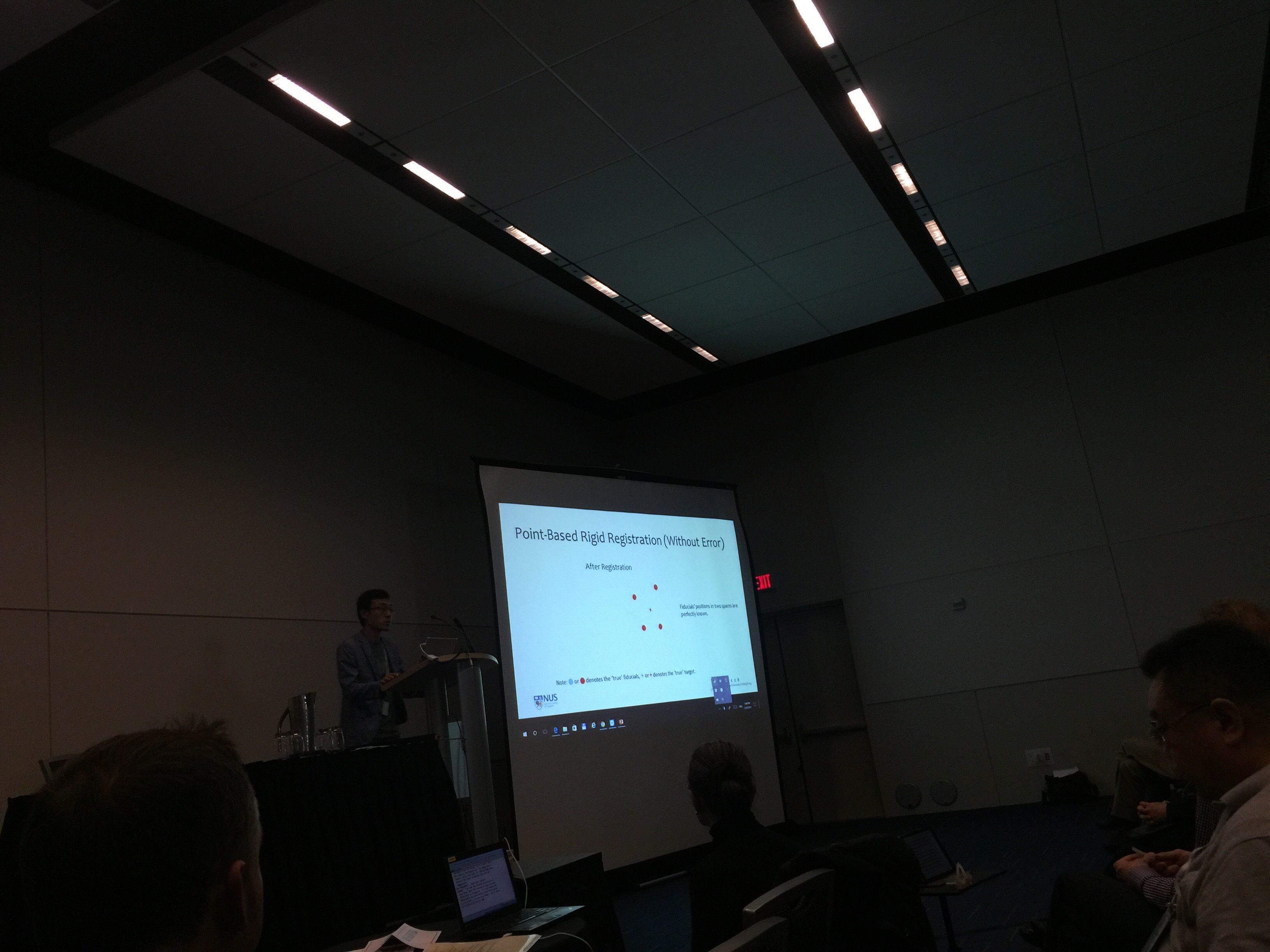
TTRE: A new type of error to evaluate the accuracy of a paired-point rigid registration
Target registration error (TRE) is widely adopted to evaluate the accuracy of a paired-point rigid registration (PPRR). However, TRE is defined in such a way that target localization error (TLE) is not considered. In this paper, we first propose a new type of error that is referred to as total target registration error (TTRE). The statistical model of TTRE is derived that we take the TLE in two spaces to be registered into consideration. Results in the first simulation show that
the developed model can accurately estimate the simulated TTRE root-mean-square (RMS) (kRMS percent differencesk< 1.5% ±2%) in all test cases. When all elements of diagonal FLE and TLE covariance matrices are independently generated from a uniform distribution that spans from 0 to 1mm and the number of fiducials N≥6, the mean and covariance matrix of TTRE are well modelled. We have also theoretically proved and validated through the second simulation that TTRE and fiducial registration error (FRE) are uncorrelated (correlation coefficient (CC) <0.1). Finally, TTRE and TRE were found to exhibit a low correlation (0.37
More Information:
Team presenting at IROS 2017
Our papers on surgical navigation and flexible robotics were presented in the conference and also Dr. Ren chaired the session for medical robotics.
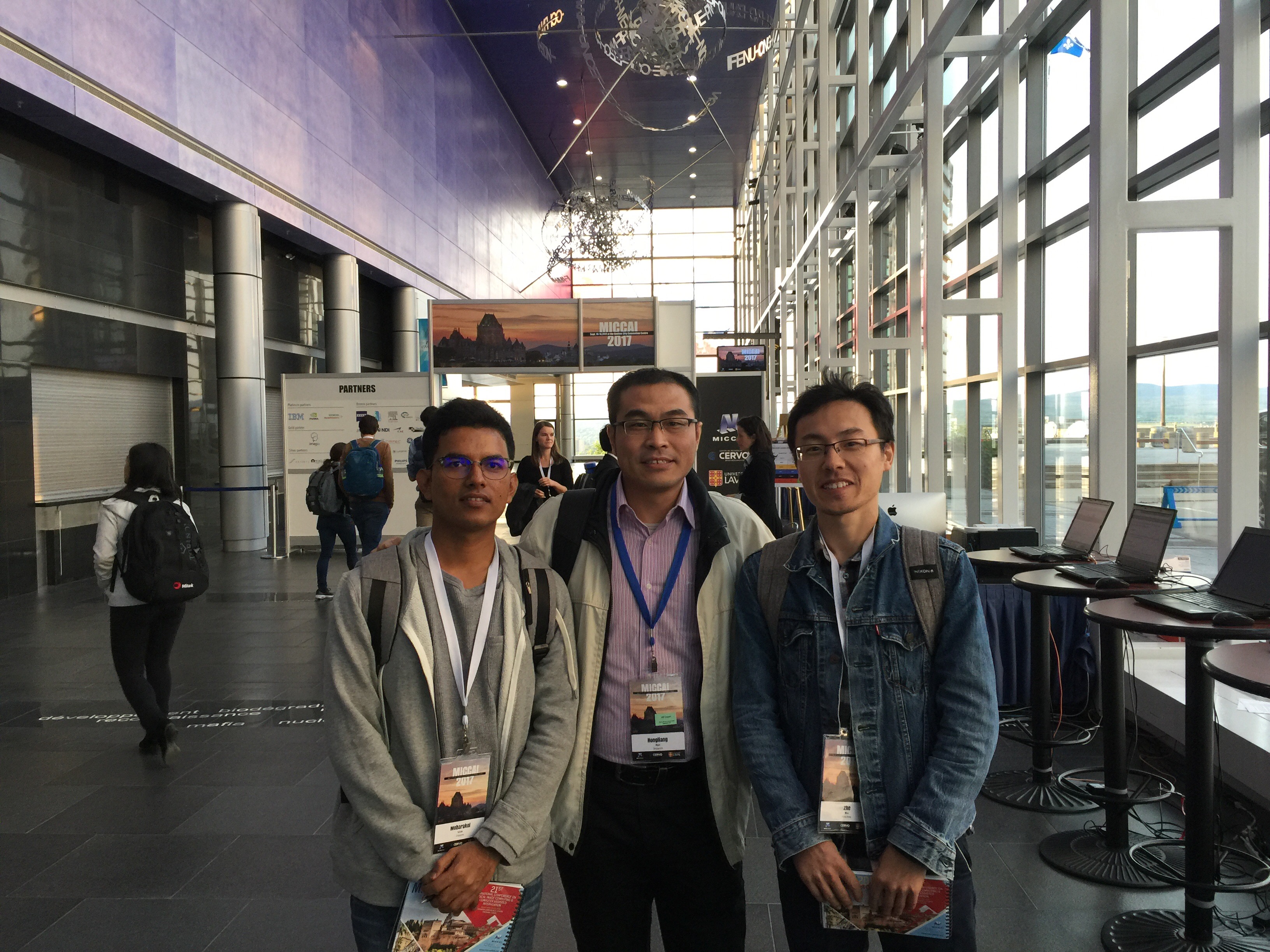
Team presenting at MICCAI
Our papers on surgical navigation and automatic medical image analysis were pretended.