A Minimal POE-Based Model for Robotic Kinematic Calibration With Only Position Measurements

Abstract

This paper proposes an algorithm for robotic kinematic calibration based on a minimal product of exponentials (POE)-based model for the applications where only position measurements are required. Both joint zero-offset errors and initial frame twist error can be involved in this model. Analysis of the identifiability of these errors shows that at most six elements of these parameters can be identified. It also suggests that at least three noncollinear points on the end-effector should be measured to maximize the identifiability. Compared with the traditional POE-based model with full pose (position and orientation) measurements, the minimal model with only position measurements outperforms in terms of convenience, efficiency, and accuracy.

full text

Towards Occlusion-Free Surgical Instrument Tracking: A Modular Monocular Approach and an Agile Calibration Method

Abstract

Optical means of instrument tracking has been widely used in image-guided interventions and considered the de facto standard for tracking rigid bodies with a direct line-of-sight. However, the occlusion problem which remains unresolved in current systems frustrates surgeons during the operation. To address this challenge, we propose a surgical instrument tracking system based on multiple reconfigurable monocular modules. The main approach is to enable the system to dynamically reconfigure the multiple monocular modules when occlusion occurs partially within the workspace. In this paper, we focus on the system architecture and an agile multicamera calibration method which only uses the customized tool for the surgical instrument tracking scenario. Additionally, two fast non-iterative algorithms are proposed and studied. In order to show the feasibility and superiority of the corresponding multicamera calibration algorithm, comparison experiments have carried out. The intensive investigation results give a practical instruction to the real implementation of the proposed system in image-guided interventions

full text

Tele-Operation and Active Visual Servoing of a Compact Portable Continuum Tubular Robot

Demo Videos

– tele-operation, visual servoing and hybrid control (Summery)

– EIH VS in free space – EIH VS inside a skull model

– Eye-to-hand Visual Servoing

Project goals

Trans-orifice minimally invasive procedures have received more and more attention because of the advantages of lower infection risks, minimal scarring and shorter recovery time. Due to the ability of retaining force transmission and great dexterity, continuum tubular robotic technology has gained ever increasing attention in minimally invasive surgeries. The objective of the project is to design a compact and portable continuum tubular robot for transnasal procedures. Several control modes of the robot, including tele-operation, visual servoing and hybrid control, have been proposed so that the robot is allowed to accomplish different tasks in constrained surgical environments.

Approaches

Driven by the need for compactness and portability, we have developed a continuum tubular robot which is 35 cm in length, 10 cm in diameter, 2.15 kg in weight, and easy to be integrated with a micro-robotic arm to perform complicated operations as shown in Fig. 1. Comprehensive studies of both the kinematics and workspace of the prototype have been carried out.
figsetup-2jbxtci
Fig. 1. Prototype of the proposed continuum tubular robot.
The workspace varies on different configuration of DOFs as well as the initial parameters of the tube pairs. The outer tubes in the following cases are all assumed to be dominating the inner tubes in stiffness. Calculation of the workspace relies on the forward kinematics of the robot, and considers the motion constraints imposed by the structure. The workspaces of the 4-DOF robot with three different initial configurations are compared in Fig. 2 (Left). Since the spatial workspace has rotational symmetry, only the sectional workspace is displayed.
fig2workspace         fig3-3dof
Fig. 2. Workspace comparison for 4-DOF CTR (Left) & 3-DOF CTR (Right) with three initial configurations. Top: all the outstretched part of the inner tube exposes; Middle: the outstretched part of the inner tube is partially covered by the outer tube; Bottom: the outstretched part of the inner tube is totally covered by the outer tube.
When the outer tube is straight, its rotation does not change either the position or the orientation of the tip. In this case, the robot degenerates to a 3-DOF one. Although decrease of DOF will weaken the dexterity of the robot, this configuration has its own advantages in some surgical applications. Take transnasal surgeries for example, as the nostril passage is generally straight, an unbent outer tube will facilitate the robot to get through at the beginning. Similar analysis of workspace is performed on the 3-DOF CTR with three different initial configurations, as shown in Fig. 2 (right). With different initial configuration, the workspaces also present different shapes.
In addition, tele-operation of the robot is achieved using a haptic input device developed for 3D position control. A novel eye-in-hand active visual servoing system is also proposed for the robot to resist unexpected perturbations automatically and deliver surgical tools actively in constrained environments. Finally, a hybrid control strategy combining teleoperation and visual servoing is investigated. Various experiments are conducted to evaluate the performance of the continuum tubular robot and the feasibility and effectiveness of the proposed tele-operation and visual servoing control modes in transnasal surgeries.

Related Publications

1. Liao Wu, Keyu Wu, Li Ting Lynette Teo, and Hongliang Ren, “Tele-Operation and Active Visual Servoing of a Compact Portable Continuum Tubular Robot in Constrained Environments”, Mechatronics, IEEE/ASME Transactions on (submitted)
2. Keyu Wu, Liao Wu and Hongliang Ren, “An Image Based Targeting Method to Guide a Tentacle-like Curvilinear Concentric Tube Robot”, ROBIO 2014, IEEE International Conference on Robotics and Biomimetics, 2014.

People involved

Staff: Liao Wu
Student: Keyu Wu
PI: Hongliang Ren

Deprecated videos FYI only

– tele-operation, visual servoing and hybrid control

– Eye-to-hand Visual Servoing

– Eye-in-hand Visual Servoing in free space

–Tele-operation of the compact tubular robot

– Eye-in-hand Visual Servoing inside a skull model

Simultaneous Hand-Eye, Tool-Flange and Robot-Robot Calibration for Co-manipulators by Solving AXB=YCZ Problem

Abstract

Multi-robot co-manipulation shows great potential to address the limitations of using single robot in complicated tasks such as robotic surgeries. However, the dynamic setup poses great uncertainties in the circumstances of robotic mobility and unstructured environment. Therefore, the relationships among all the base frames (robot-robot calibration) and the relationships between the end-effectors and the other devices such as cameras (hand-eye calibration) and tools (tool-flange calibration) have to be determined constantly in order to enable robotic cooperation in the constantly changing environment. We formulated the problem of hand-eye, tool-flange and robot-robot calibration to a matrix equation AXB=YCZ. A series of generic geometric properties and lemmas were presented, leading to the derivation of the final simultaneous algorithm. In addition to the accurate iterative solution, a closed-form solution was also introduced based on quaternions to give an initial value. To show the feasibility and superiority of the simultaneous method, two non-simultaneous methods were also proposed for comparison. Furthermore, thorough simulations under different noise levels and various robot movements were carried out for both simultaneous and non-simultaneous methods. Experiments on real robots were also performed to evaluate the proposed simultaneous method. The comparison results from both simulations and experiments demonstrated the superior accuracy and efficiency of the simultaneous method.

Problem Formulation

Measurement Data:
Homogeneous transformations from the robot bases to end-effector (A and C), and from tracker to marker (B).
Unknowns:
Homogeneous transformations from one robot base frame to another (Y), and from eye/tool to robot hand/flange (X and Z).
The measurable data A, B and C, and the unknowns X, Y and Z form a transformation loop which can be formulated as, AXB=YCZ (1).
problem

Fig. 1: The relevance and differences among the problem defined in this paper and the other two classical problems in robotics. Our problem formulation can be considered as a superset of the other two.

Approaches

Non-simultaneous Methods

3-Step Method
In the non-simultaneous 3-Step method, the X and Z in (1) are separately calculated as two hand-eye/tool-flange calibrations which can be represented as an AX = XB problem in the first and second steps. This results in two data acquisition procedures, in which the two manipulators carry out at least two rotations whose rotational axes are not parallel or anti-parallel by turns while the other one being kept immobile. The last unknown robot-robot relationship Y could be solved directly using the previously retrieved data by the method of least squares.
2-Step Method
The non-simultaneous 2-Step method formulates the original calibration problem in successive processes which solve AX = XB firstly, and then the AX = YB. The data acquisition procedures and obtained data are the same with the 3-Step method. In contrast to solving robot-robot relationship independently, the 2-Step method solves tool-flange/hand-eye and robot-robot transforms in an AX = YB manner in the second step. This is possible because equation AXB = YCZ can be expressed as (AXB)inv(Z) = YC, which is in an AX = YB form with the solution of X known.

Simultaneous Method

Non-simultaneous methods face a problem of error accumulation, since in these methods the latter steps use the previous solutions as input. As a result, the inaccuracy produced in the former steps will accumulate to the subsequent steps. In addition to accuracy, it is preferred that the two robots participating the calibration procedure simultaneously, which will significantly save the total time required.
In regards to this, a simultaneous method is proposed to improve the accuracy and efficiency of the calibration by solving the original AXB = YCZ problem directly. During the data acquisition procedure, the manipulators simultaneously move to different configurations and the corresponding data set A, B and C are recorded. Then the unknown X, Y and Z are solved simultaneously.

Evaluations

Simulations

To illustrate the feasibility of the proposed methods, intensive simulations have been carried out under different noise situations and by using different numbers of data sets.
simulation

Fig. 2: A schematic diagram which shows the experiment setup consisting of two Puma 560 manipulators, a tracking sensor and a target marker to solve the hand-eye, tool-flange and robot-robot calibration problem.

Simulations Results

For the rotational part, the three methods perform evenly in the accuracy of Z. However, the simultaneous method slightly outperforms in the accuracy of X and significantly in the accuracy of Y than the other two non-simultaneous methods. The results of the translational part are similar to the rotational ones. For the solution of Z, the accuracy of the simultaneous method is as good as the 3-Step method but slightly worse than the 2-Step method. However, the simultaneous method achieves a significantly improvement in the accuracy of X and Y compared to the other two methods.
 
simulation1
simulation2
simulation3

Experiments Results

Besides the simulation, ample real experiments have been conceived and carried out under different configurations to evaluate the proposed methods. As shown in Fig. 6, the experiments involved a Staubli TX60 robot (6 DOFs, averaged repeatability 0.02mm), a Barrett WAM robot (4 DOFs, averaged repeatability 0.05mm) and a NDI Polaris optical tracker (RMS repeatability 0.10mm). The optical tracker was mounted to the last link of the Staubli robot, referred to as sensor robot. The corresponding reflective marker was mounted to the last link of the WAM robot, referred to as marker robot.
experiment

Fig. 6: The experiment is carried out by using a Staubli TX60 robot and a Barrett WAM robot. A NDI Polaris optical tracker is mounted to the Staubli robot to track a reflective marker (invisible from current camera angle) that is mounted to the WAM robot.

To demonstrate the superiority of the simultaneous method in the real experimental scenarios, a 5-fold cross-validation approach is implemented for 200 times for all the calibration methods under all system configurations. For simultaneous method, after data alignment and RANSAC processing, 80% of the remaining data are randomly selected to calculate unknown X, Y, and Z, and 20% are used as test data to evaluate the performance. For 2-Step and 3Step methods, after calculating the unknowns by each method, same test data from the simultaneous method are used to evaluate their performances.

In Fig. 7, the evaluated errors of 200 times 5-fold cross-validation for three proposed methods at three ranges are shown as box plots. Left-tail paired-samples t-tests have been carried out to compare the performances of simultaneous method versus 2-Step and 3-Step methods, respectively. The results indicate that the rotational and translational errors from the simultaneous method are very significantly smaller than the 2-Step and 3-Step methods. Only two non-significant results exist in the rotational performances at medium and far ranges when comparing the simultaneous method with the 3-Step one. Nevertheless, the simultaneous method outperforms the non-simultaneous ones for translation error at all ranges.

experiment1

Fig. 7: Results of 200 times 5-fold cross-validation and left-tail paired-samples t-test at the near, medium and far ranges. The box plots show the rotational and translational error distributions for three methods at three ranges. **, * and N.S. stands for very significant at 99% confidence level, significant and non-significant at 95% confidence level.

Related Publications

1. Liao Wu, Jiaole Wang, Max Q.-H. Meng, and Hongliang Ren, imultaneous Hand-Eye, Tool-Flange and Robot-Robot Calibration for Multi-robot Co-manipulation by Solving AXB = YCZ Problem, Robotics, IEEE Transactions on (Conditionally accepted)
2. Jiaole Wang, Liao Wu and Hongliang Ren, Towards simultaneous coordinate calibrations for cooperative multiple robots, Intelligent Robots and Systems (IROS 2014), 2014 IEEE/RSJ International Conference on. IEEE, 2014: 410-415.

Institute & People Involved

The Chinese University of Hong Kong (CUHK): Jiaole Wang, Student Member, IEEE; Max Q.-H. Meng, Fellow, IEEE
National University of Singapore (NUS): Liao Wu; Hongliang Ren, Member, IEEE

Videos

-Calibration Experiments
 

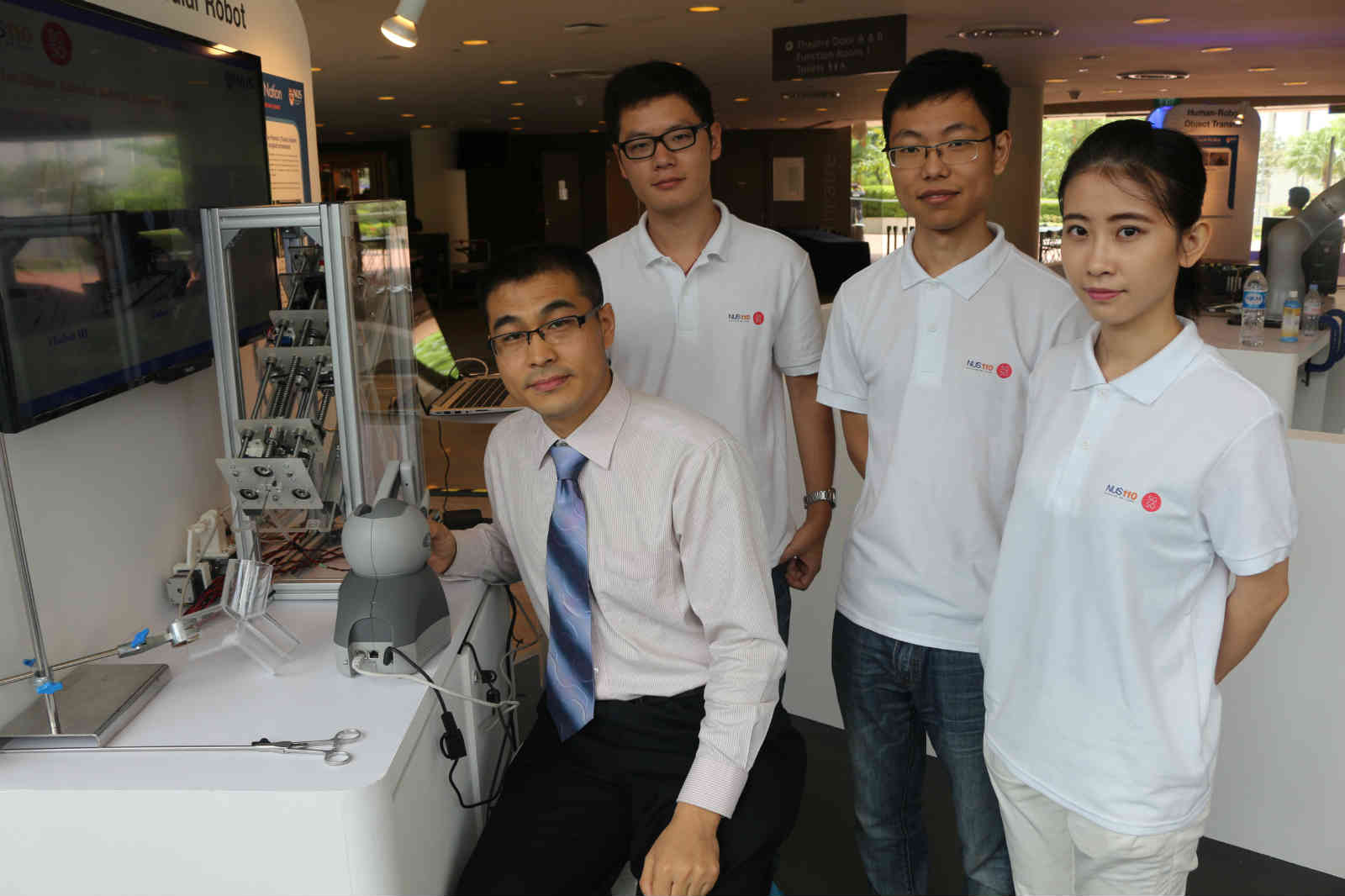
NUS S&T Exhibition Launch at UCC

(9 April 2015) We have been invited to demonstrate our Intelligent Tubular Robotic System (iTubot) at the exhibition showcasing NUS’ contribution to nation-building through groundbreaking research. The event launched at the University Cultural Centre on 9 April to celebrate the 50th birthday of Singapore and the 110th birthday of NUS.

Our Intelligent Tubular Robotic System can potentially assist with minimally invasive procedures and is also endowed with intelligent navigation capabilities, which receives much attention during the event.

IMG_4251_meitu_3


Useful Checklists/Guides to Improve Research Skills

Useful Checklists/Guides (Selected)

  • How to undertake a literature search and review: for dissertations and final year projects [PDF]
  • Writing the Literature Review / Using the Literature [PDF]
  • Referencing: Why, when and how [PDF]
  • Minor thesis & research report structure [PDF]
  • Features of good reports [PDF]
    • A checklist for effective reports [PDF]
  • Undergraduate research report [PDF]
  • Oral presentations [PDF]

Useful Checklists/Guides (General ones):

  • 1. Research Proposal and Formulation:
    • Generating ideas & forming a question (University of Reading) [PDF]
  • 2. Reading Skills:
  • 3. Literature Review:
    • Getting Started on Your Literature Review (UNSW) [PDF]
    • How to undertake a literature search and review: for dissertations and final year projects (DMU) [PDF]
    • Literature Review: Academic Tip Sheet (Edith Cowan University) [PDF]
    • Literature review (tutorial) [RMIT]
    • Writing a Literature Review (UNSW) [PDF]
    • Writing the Literature Review / Using the Literature (RMIT) [PDF]
  • 4. Referencing:
    • Chicago Author-Date Referencing (Curtin University) [PDF]
    • Havard System (Bournemouth University) [PDF]
    • The Harvard system of referencing (DMU) [PDF]
    • Referencing: Why, when and how (Lincoln University) [PDF]
  • 5. Report/Thesis Organisation & Planning:
    • A Report Checklist (Lincoln University) [PDF]
    • Features of good reports (University of Reading) [PDF]
    • Minor thesis & research report structure (RMIT) [PDF]
    • Structuring your report (University of Reading) [PDF]
    • Undergraduate research report [PDF]
  • 6. Report/Thesis Writing:
    • Abstract Preparation Guidance (HKU Graduate School) [website]
    • Paraphrasing, Summarising & Quoting (UNSW) [PDF]
    • Writing a research report (RMIT) [PDF]
    • Writing critically?(Lincoln University) [PDF]
  • 7. Oral presentations:

Communication Skills:

  • Guidelines for Effective Oral and Written Communications [PDF]
  • Making a Presentation [PDF]
  • Engineering an Effective PowerPoint Presentation [PDF]
  • Mastering Technical Writing [PDF]
  • Scholarship and Intellectual Property [PDF]

Literature Search and Review Skills:

Presentation Skills:

Project Management:

Research Skills:

Writing Skills:

Reference

www.mech.hku.hk/bse/bbse3002

Nonlinear Fuzzy Linguistics for the Determination of Nitrogen Monoxide, Nitrogen Dioxide, and Sulfur Dioxide by Molecular Absorption Spectroscopy

Abstract

The nonlinearity and high dimensionality of spectra affect the precision and the complexity of molecular absorption spectroscopy models. This paper reports a nonlinear fuzzy linguistic method for spectroscopic quantitative analysis. A nonlinear fuzzy linguistic rule is presented. In the rule antecedent, a set operation was used to express the input variables and the fuzzy linguistic terms. A flexible polynomial equation of the input variables was a consequential rule. The fuzzy linguistic terms, the membership functions, and the nonlinear linguistic rules were initialized automatically by Gaussian kernel fuzzy clustering analysis, and the related parameters of nonlinear fuzzy linguistic rules were tuned by the iterative optimization for minimizing the root-mean square error. The principal components of the absorption measurements were extracted as input variables to reduce the complexity of the model. Experimental measurements employed a spectral dataset of flue gas for quantitative determination of the components that included sulfur dioxide, nitric oxide, and nitrogen dioxide. The experimental results verify the effectiveness of the theoretical approach.

full text