Motion Planning of Flexible Manipulators by Learning from Human Expert Demonstrations

Abstract

Motion Planning of Multiple-segment flexible soft, and continuum Flexible Manipulators by Learning from Human Expert Demonstrations

Multiple-segment flexible and soft robotic actuators exhibit compliance but suffer from the difficulty of path planning due to their redundant degrees of freedom, although they are promising in complex tasks such as crossing body cavities to grasp objects. We propose a learning from demonstration method to plan the motion paths of flexible manipulators, by statistics machine-learning algorithms. To encode demonstrated trajectories and estimate suitable paths for the manipulators to reproduce the task, models are built based on Gaussian Mixture Model and Gaussian Mixture Regression respectively. The forward and inverse kinematic models of soft robotic arm are derived for the motion control. A flexible and soft robotic manipulator verifies the learned paths by successfully completing a representative task of navigating through a narrow keyhole.


 

Demo video at:


Publications

  • H. Wang; J. Chen; H. Y. Lau & H. Ren Motion Planning of IPMC Flexible Manipulators by Learning from Human Expert Demonstrations ICRA2016, IEEE International Conference on Robotics and Automation, 2016
  • J. Chen; H. REN & A. Lau Learning Reaching Movement Primitives from Human Demonstrations with Gaussian Mixture Regression and Stabilized Dynamical Systems International Conference on Control Science and Systems Engineering ICCSSE 2016, 2016
  • J. Chen; W. Xu; A. Lau & H. REN Towards Transferring Skills to Flexible Surgical Robots with Programming by Demonstration and Reinforcement Learning The Eighth International Conference on Advanced Computational Intelligence (ICACI2016), 2016
  • J. Chen; W. Xu; H. Ren & H. Y. Lau Automate Adaptive Robot Reaching Movement Based on Learning from Human Demonstrations with Dynamical Systems ROBIO2016, 2016

Best Student Paper for IEEE RCAR2016

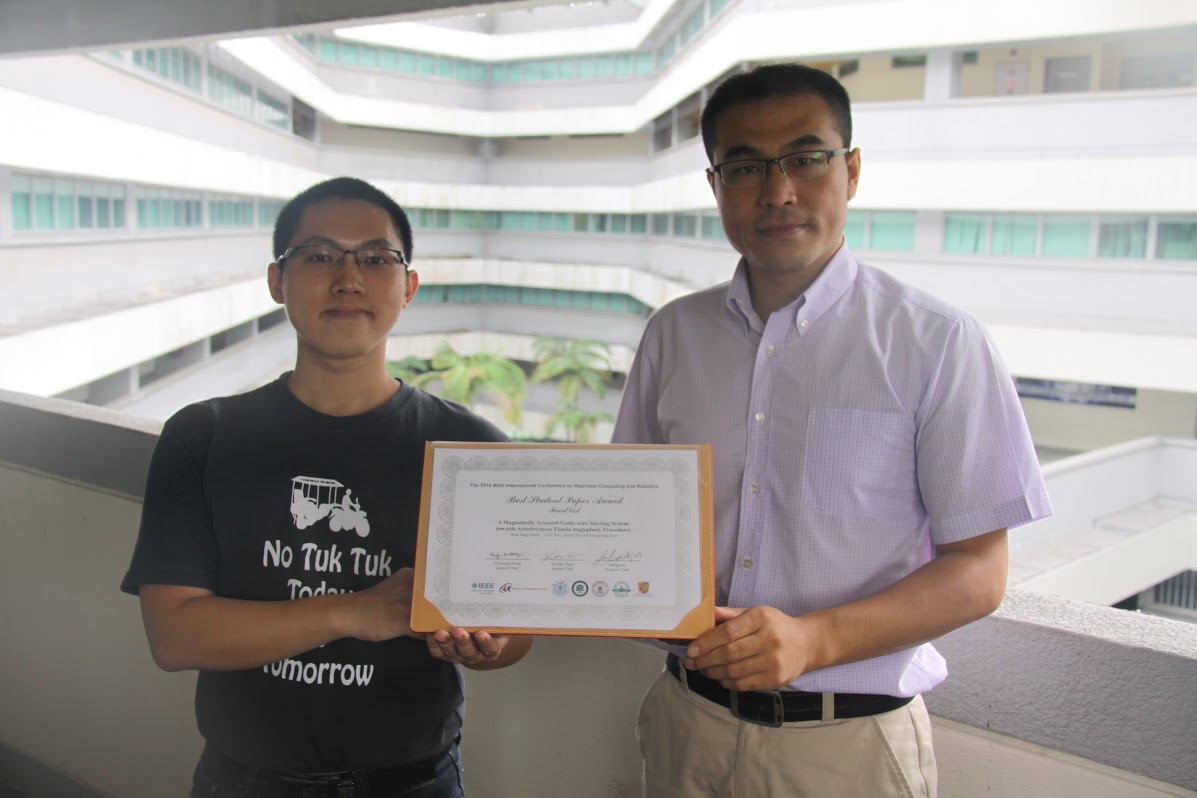
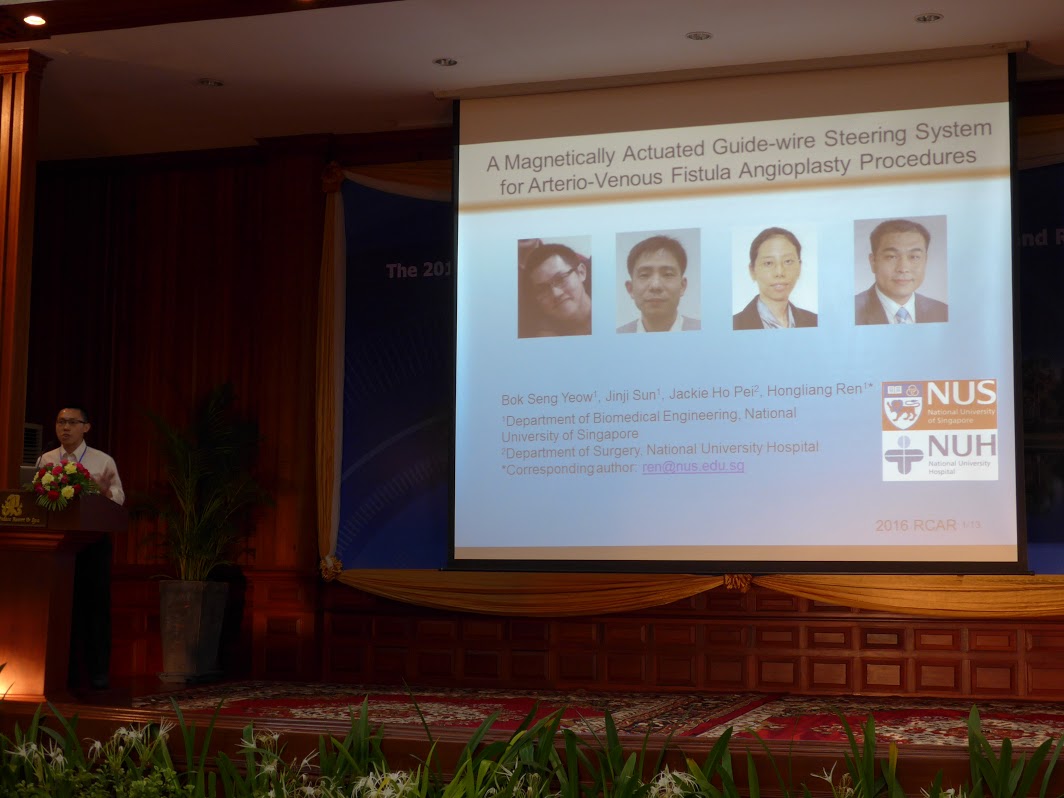
Our paper titled “Towards Magnetically Actuated Guide-wire Steering in Arteriovenous Fistula Angioplasty Procedures” was awarded for the Best Student Paper at IEEE Conference on Real-time Computing and Robotics (RCAR), June 6 to 10, 2016, at Angkor Wat, Cambodia.
RCAR-2

RCAR-IMG_5758

A Magnetically actuated guide-wire steering system towards arteriovenous fistula angioplasty procedures

Abstract

Working towards remote steering of distal guide-wire in arteriovenous fistula angioplasty procedures, we develop a magnetically actuated robotic guide-wire manipulation system involving electromagnetic coils and a flexible guide-wire with a magneto-responsive attachment. By varying the coil voltages, we show the controlled deflections of the distal guide-wire. Specifically we are investigating the guidewire actuation mechanism under controlled electromagnetic field, the transfer function of the system, and the steering experiments in a custom phantom. The studied phenomenon has importance for guide-wire placement in minimally invasive cardio-vascular surgeries. A video demonstration is available at: http://bioeng.nus.edu.sg/mm/magnetically-actuated-guide-wire-steering.

More information

Full text and more information

Soft haptics using soft actuator and soft sensor

Abstract

In this paper, we presented fabric-based soft tactile actuator and soft sensor. The force characterization result indicates that the actuator is able to produce force up to about 2.20(ยฑ0.017)N, when it is supplied with 80kPa of pressurized air. Hence it is capable of producing sufficient amount of force, which surpasses the human’s haptic perception threshold. The thin, sheet nature of the material creates lightweight actuator, which improves the payload-to-weight ratio. The pneumatic-based operation principle creates a safer human-machine interface. Thus, it eliminates possible occurrence of safety issues such as the danger of applying high voltages to user’s skin in case of malfunction. Direct force coupling of the soft actuator with the sensor is established to enable transmission of force information from the sensor to the actuator. The test profile indicates that the actuator is able to produce similar force profile as that of the sensor. This opens up possibility of developing soft tactile sensors and actuators based gloves, which can be paired and applied in virtual-reality based training and rehabilitation programs. Superimposition of multiple soft actuators would create an array that provides shape and size specific haptic feedback.

More information

Full text and more information

FPGA implementation of a FA-1 mechanoreceptor model for efficient representation of tactile features

Abstract

Spatiotemporal spike patterns from a population of mechanoreceptors provide a concise representation of tactile stimuli that facilitates rapid sensory processing in the brain. Efficient models of mechanoreceptors are needed for the adoption of spike-based processing for robotic tactile sensing applications. This paper presents a biomimetic model of the fast-adapting type 1 (FA-1) mechanoreceptor, implemented on a field-programmable-gate-array (FPGA). The simplicity of this model enables its realization on large arrays of sensing elements while operating with sub-millisecond temporal precision required to capture deformation patterns. We illustrate this capability by interfacing with a 4096 element tactile sensor array with a 5.2 kHz sampling rate. Through physical experiments, we demonstrate the discrimination of force magnitude and local curvature during transient mechanical contact, using spike patterns obtained from the model. The approach has the potential to deliver responsive full-body tactile sensing in robotic and prosthetic applications.

More information

Full text and more information

Design, kinematics, simulation of omni-directional bending reachability for a parallel structure forceps manipulator

Abstract

This paper presents a 5-DOF manipulator which consists of three parts, 1-DOF translational joint, a bendable skeleton (2-DOF for Omni-directional bending motion), and a rotatable forceps gripper (1-DOF for rotation, 1-DOF for opening/closing). The bendable segment in the manipulator achieves two orthogonal bending DOFs by pulling or pushing three parallel universal-joint-based shaft chains. Forward and inverse kinematics of the bendable skeleton is analyzed. The workspace calculation illustrates that the structure of the three parallel shaft chains can reach a bending angle of 90 degree in arbitrarily direction. The reachability of the manipulator is simulated in Adamsยฎ. According to the surgical requirements, the manipulator is actuated to draw circle during the tests while the end effector is kept bending at 60 degree. The results show that the end effector can precisely track the planning trajectory (precision within 1 mm).

More information

Full text and more information

Delicate manipulations with compliant mechanism and electrostatic adhesion

Traditional rigid robotic hand manipulator has been used in many field nowadays due to its advantages of large gripping force and stable performance. However, this kind of rigid manipulator is not suitable for gripping fragile objects since it is motorized and force control can be a problem. It is also not suitable to grip object with different shapes since the manipulator is rigid and not compliant. In this study, a novel manipulator with gripping capability is designed and fabricated. The manipulator combines electrostatic adhesion actuation with soft manipulators. The manipulator has high flexibility and can be compliant to different shapes due to the property of the materials. It is very promising to do delicate manipulations in industry field and biomedical field.

More information

Full text and more information

A compliant modular robotic hand with fabric force sensor for multiple versatile grasping modes

Abstract

This paper presents the development of a compliant, modular, reconfigurable, and sensorized robotic hand with multiple grasping capabilities. Each finger consists of a soft pneumatic actuator with embedded fabric force sensor and a detachable casing. The casing has a through hole for housing the actuator and special connectors for attachment to other casings. One casing each from the thumb and finger parts has a protrusion for connecting both parts together via a screw tightening system. The through-hole design allows different grasping length to be achieved and the inflated pneumatic channel of the actuator locks it in place. The modular robotic hand is capable of various versatile grasping tasks by simply changing the bending direction of the actuator, the distance between the thumb and finger parts, the grasping length of the actuator, or attaching/detaching additional fingers to the hand. (1) Hook grasping with single finger, (2) pinching with pad opposition, (3) reverse grasping for holding a pipe-like object, (4) wrap grasping with palm opposition, as well as (5) picking up an object through its handle with one thumb and two or more fingers were illustrated. These studies show the capability of the compliant modular robotic hand in performing various types of grasping by simply using different configurations of the casings. The excellent payload-to-weight ratio of the robotic hand was demonstrated. Also, the fabric force sensor that was embedded in the soft actuator indicated the difference in grasping forces that were applied to different objects during hook grasping. The modular robotic hand has the potential to broaden or substitute the usage of existing robotic hands, especially in applications where soft versatile configurable grasping is desired.

More information

Full text and more information