Our article featured on the cover of IEEE Sensor Journal

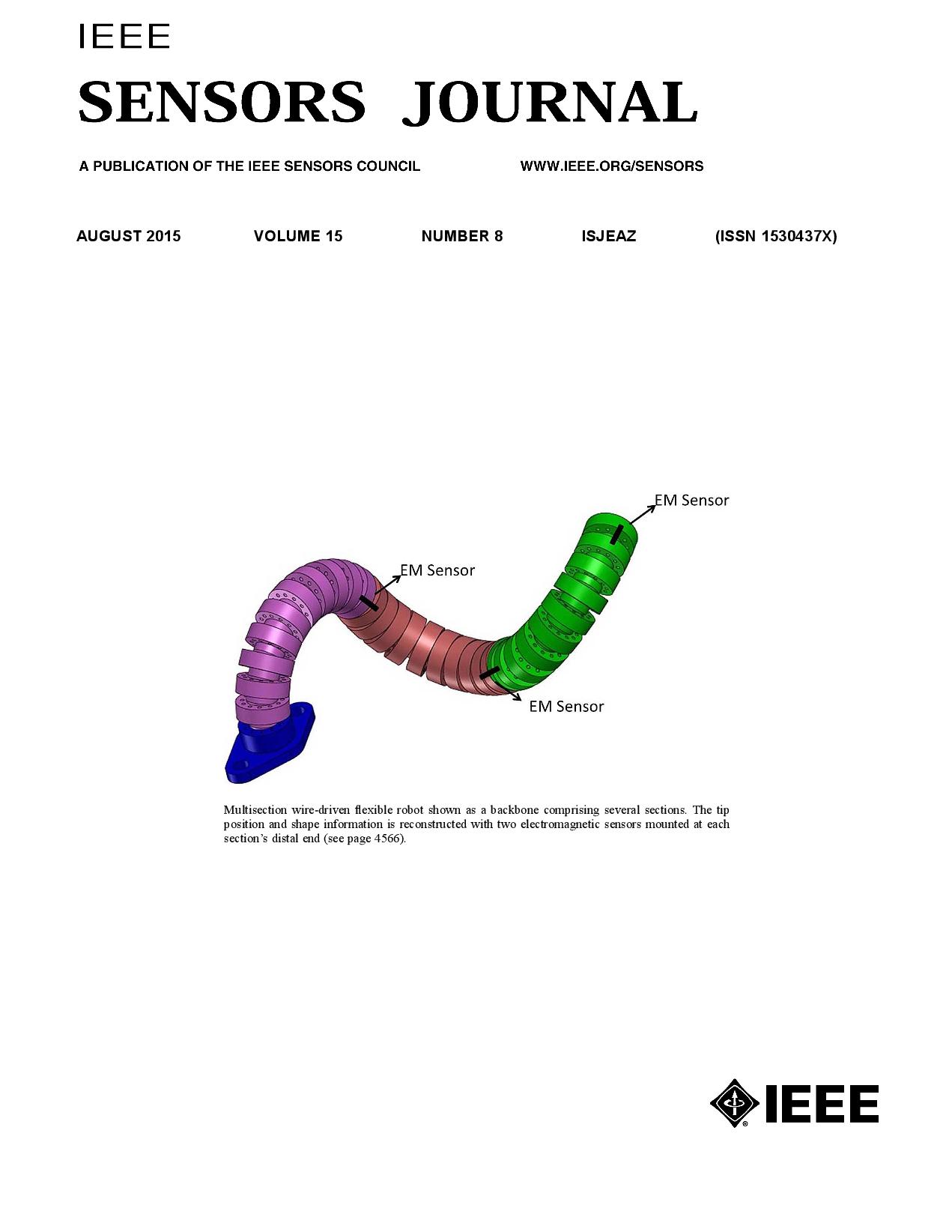
Out of 72 articles in the same issue, our paper on flexible robotic sensing, entitled “Electromagnetic Positioning for Tip Tracking and Shape Sensing of Flexible Robots”, was ย featured on the cover ofย IEEE Sensor Journal,ย  (Volume:15 , Issue: 8, Issue Date: Aug. 2015).
ieeeSensorCover07155612-page-001

For more information about the paper, please check http://ieeexplore.ieee.org/xpl/login.jsp?tp=&arnumber=7088545 and Cover.pdf

ICORR at NTU

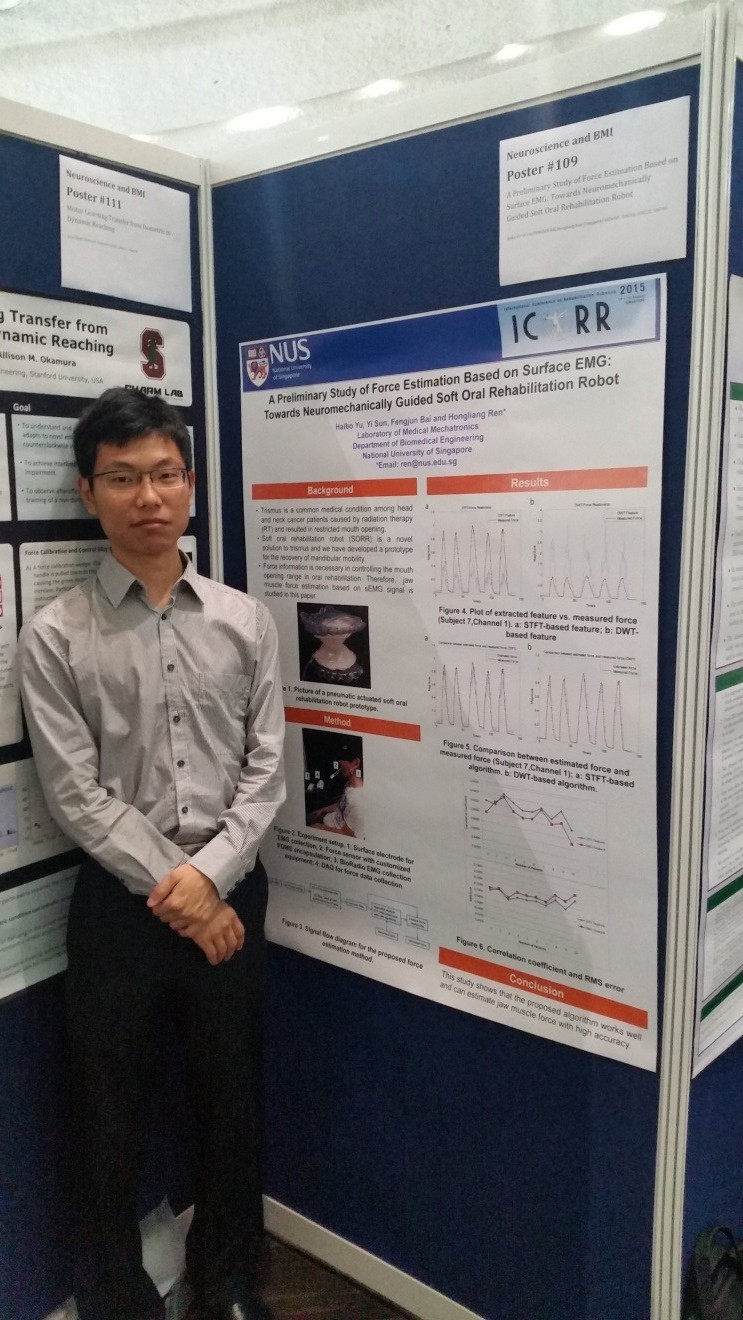
This year, the 14th edition of the IEEE/RAS-EMBS International Conference on Rehabilitation Robotics (ICORR 2015) was hold in Singapore and our paper titled โ€˜A Preliminary Study of Force Estimation Based on Surface EMG: Towards Neuromechanically Guided Soft Oral Rehabilitation Robotโ€™ was selected for poster presentation.

icorr

Best Paper Finalist award at ICIA 2015 Conference

During the recent IEEE ICIA/ICAL 2015 conference, we presentedย two papers including:

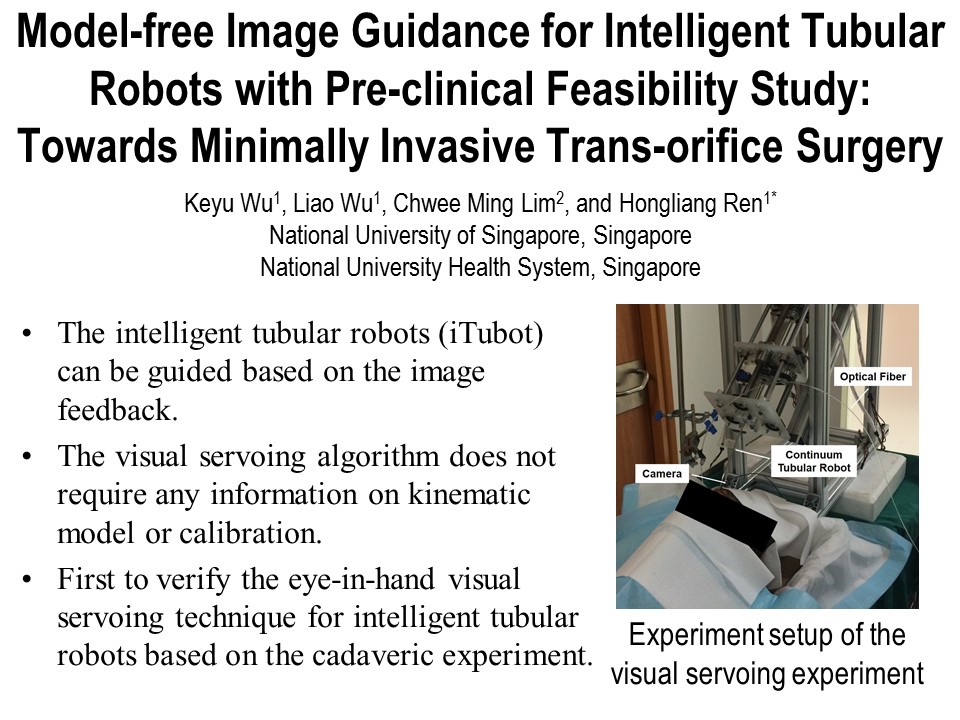
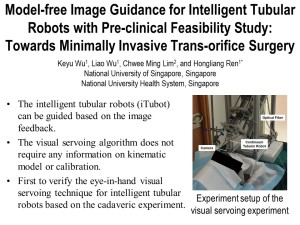
1. Keyu Wu, Liao Wu, Chwee Ming Lim, Hongliang Ren. Model-free Image Guidance for Intelligent Tubular Robots with Pre-clinical Feasibility Study: Towards Minimally Invasive Trans-orifice Surgery.
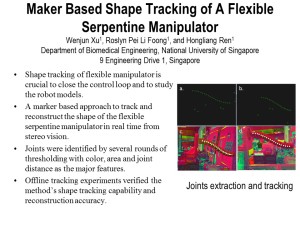
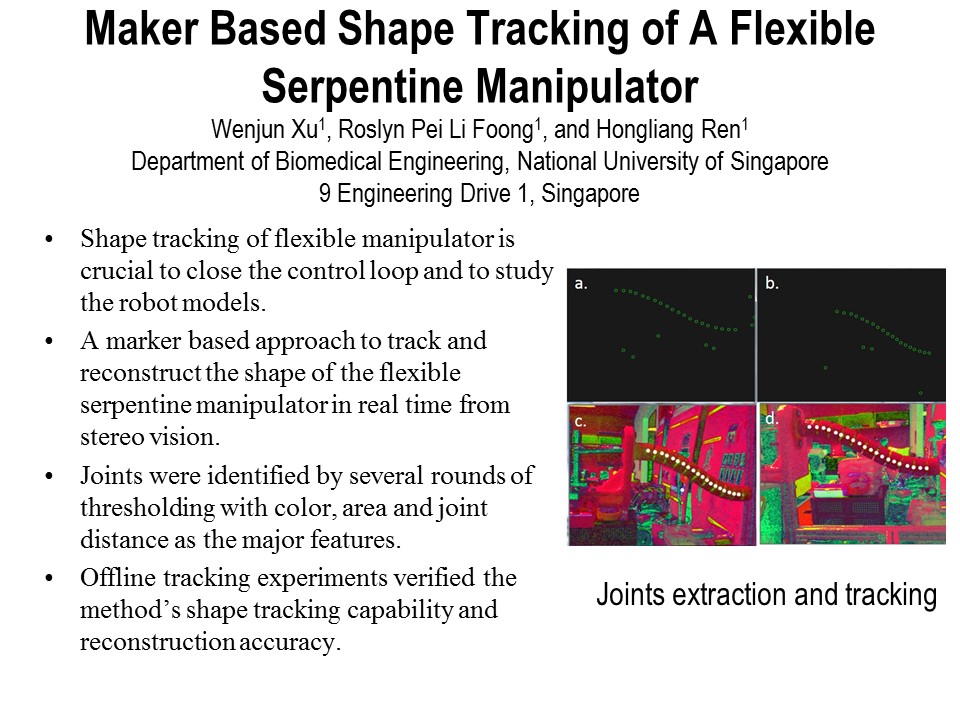
2.ย Wenjun Xu, Roslyn Pei Li Foong, Hongliang Ren. Marker Based Shape Tracking of A Flexible Serpentine Manipulator.

Besides, the first paper also won the Best Paper Finalist award.
647 Digest PPT4web Digest-PPT-WenjunICIA4web

More information about the ICIA conference: The IEEE ICIA/ICAL 2015 joint conference (IEEE International Conference on Information and Automation & IEEE International Conference on Automation and Logistics) was held from August 8 to 10, 2015 in the old town of Lijiang, located in the beautiful Yunnan province of China. The IEEE ICIA/ICAL 2015 joint conference providedย the participants with excellent technical and social programs. Papers with high quality were presented to demonstrate original research results and innovations in all aspects of information, automation, logistics, and their applications.


Model-free Image Guidance for Intelligent Tubular Robots with Pre-clinical Feasibility Study: Towards Minimally Invasive Trans-orifice Surgery

Abstract

Comprised of multiple curved concentric tubes, continuum tubular robots are capable to reach surgical targets while bypassing critical anatomical obstacles during minimally invasive surgeries, such as transnasal and transoral surgeries. To automatically track the surgical target and compensate undesired disturbance, an eye-in-hand image-based visual servo algorithm is presented in this paper to control in-house continuum tubular robots. The proposed visual servoing approach does not require any prior knowledge of kinematic models of the robots in order to avoid the errors introduced by imaging-sensor calibration and 3D position reconstruction. Preclinical cadaveric experiments have been demonstrated in the paper to illustrate the feasibility of the model-free automatic visual serving method

full text

Electromagnetic Positioning for Tip Tracking and Shape Sensing of Flexible Robots

Abstract

Wire-driven flexible robots are efficient devices for minimally invasive surgery, since they can work well in complex and confined environments. However, the real-time positional and shape information of the robot cannot be well estimated, especially when there is an unknown payload or force working on the end effector. In this paper, we propose a novel tip tracking and shape sensing method for wire-driven flexible robots. The proposed method is based on the length of each section of the robot as well as the positional and directional information of the distal end of each section of the robot. For each section, an electromagnetic sensor will be mounted at the distal end to estimate the positional and directional information. A reconstruction algorithm, which is based on a three-order Bรฉzier curve, is carried out utilizing the positional and directional information along with the length information of the section. This method provides the advantage of good tracking results and high shape reconstruction accuracy with limited modification to the robot. Compared with other reconstruction methods, no kinematic model is needed for reconstruction. Therefore, this method works well with an unknown payload that applied at the tip of the robot. The feasibility of the proposed method is verified by simulation and experimental results.