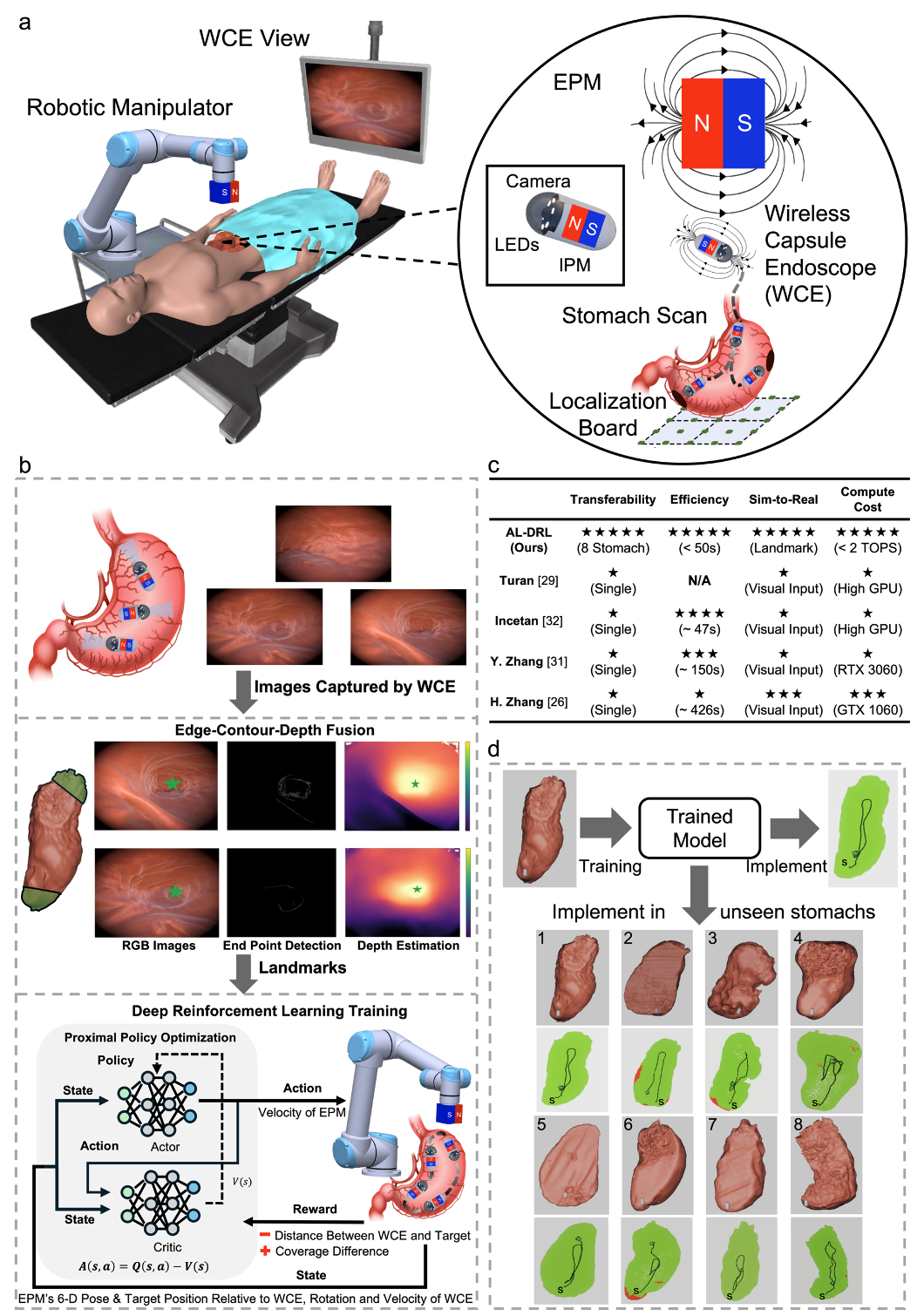
Thrilled to share our latest Advanced Science work on enabling highly transferable, autonomous navigation for wireless capsule endoscopy (WCE)—using a lightweight Edge-Contour-Depth Fusion module and deep reinforcement learning (DRL).
WCE has revolutionized GI diagnostics, but its potential is often restricted by incomplete mucosal coverage and the poor ability of existing AI navigation methods to adapt across different patient anatomies. This motivated us to ditch the heavy, brittle, traditional “end-to-end” visual video streams that cause AI models to overfit to a single patient.
🧠✨ What we developed:
A unified, clinically viable framework that features:
🔹 Anatomical Landmark Guidance: Operates on stable, low-dimensional coordinates of conserved gastric structures (the fundus and pyloric antrum) rather than high-dimensional raw video.
🔹 Lightweight Perception Module: Combines classical Canny edge detection and Hu moments with a compact monocular depth network (DispNet) to run efficiently on low-power clinical hardware.
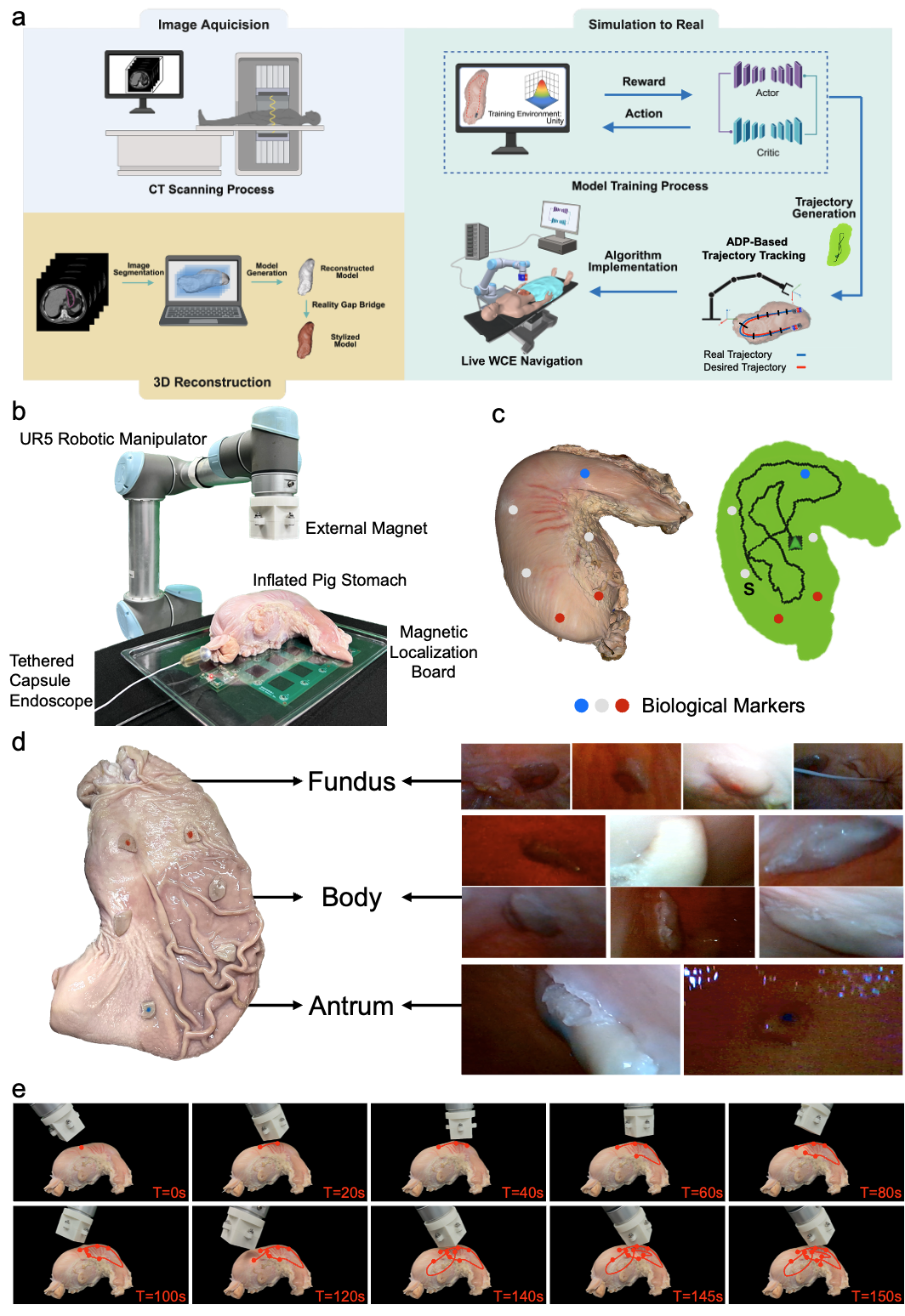
🔹 Robust Sim-to-Real Pipeline: Utilizes a patient-specific digital twin combined with a model-free Adaptive Dynamic Programming (ADP) controller to actively neutralize real-world physical disturbances and actuator latency.
🎯 Key Results:
✅ >97% mucosal coverage achieved within 50 seconds across 8 diverse, patient-derived stomach models in simulation.
✅ 87% mean coverage stability and a 53% reduction in procedure time during real-world ex-vivo experiments compared to expert manual control.
✅ Drastically reduced computational overhead, allowing deployment on low-cost processors (<2 TOPS).
💡 Why it matters:
This study establishes a scalable paradigm that conquers the “reality gap” and patient anatomical variability in medical robotics. By decoupling perception from control, it removes the need for expensive, massive patient datasets and high-end GPUs, paving the way for operator-independent, intelligent GI diagnostics.
🌱 What’s next?
We are expanding our training to encompass extreme pathological distortions (like hiatal hernias) and advancing toward fully wireless clinical deployment with dynamic, target-reaching capabilities for intraoperative pathologies.
🔗 Paper Link: https://advanced.onlinelibrary.wiley.com/doi/10.1002/advs.202600008